
Imagine a young woman standing in front of the music stand in her rehearsal room. She has been working on a high passage for an hour, but it is not getting any better - she feels pressure in her throat and her tone does not have the radiance she would like. As she looks sideways in the mirror while singing, she notices that her chest is slightly sunken and her chin has moved forwards unnoticed. It's a typical „relaxed posture“ that you often see in people who sit at a desk all day.
Find your body plumb line
If you have already noticed such a slumped posture in yourself, take a look in the mirror and try to find your „body plumb line“. This is an imaginary line that ideally balances your posture, shown here in the picture:
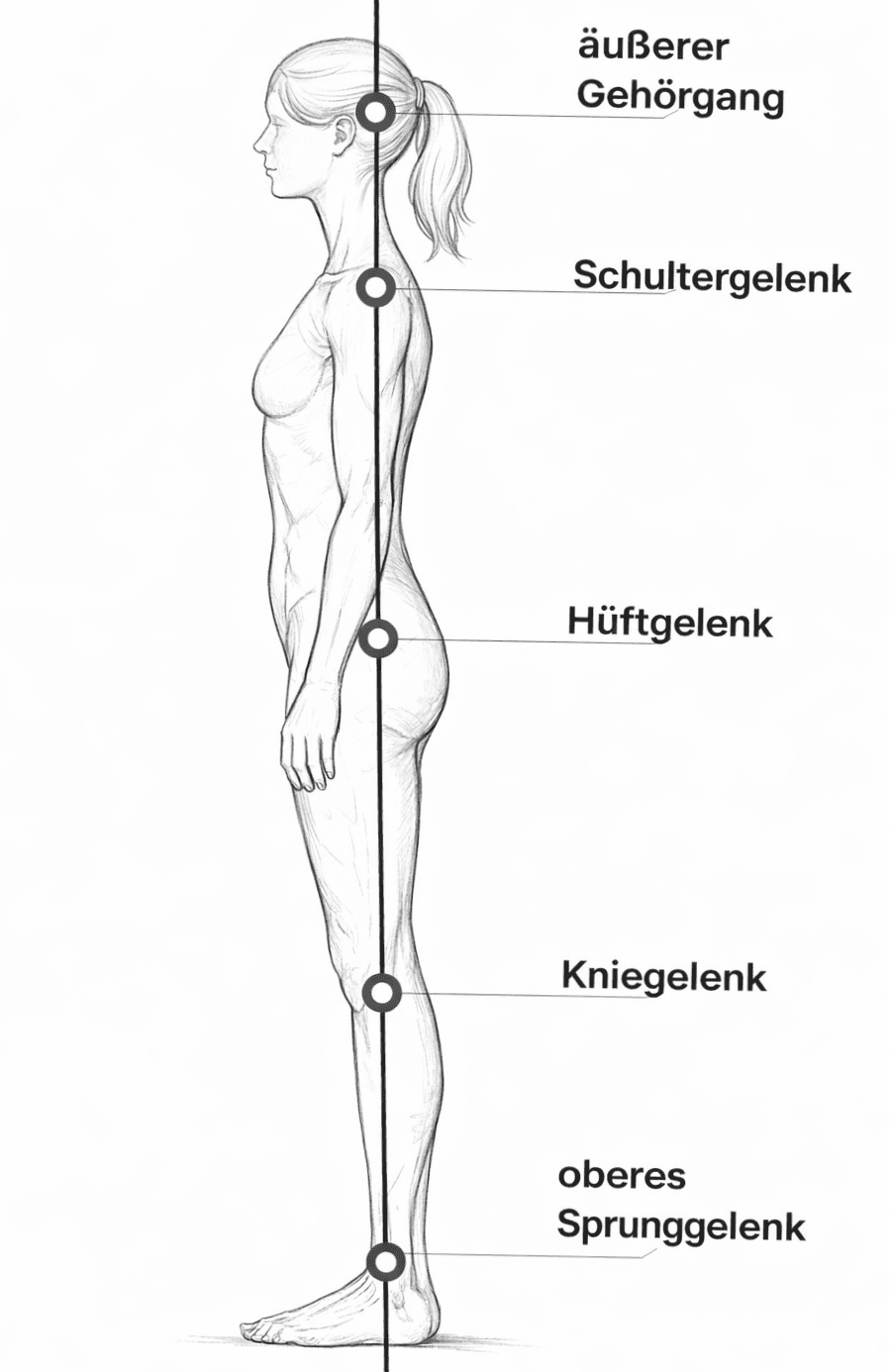
In this position, „perpendicular“, the joints are balanced on top of each other in such a way that the muscle effort against gravity is minimised. It is best to stand with your feet shoulder-width apart and your knees loosely extended. Your hips are upright and your chest is lifted. Your shoulder girdle is relaxed in the centre and your arms hang down loosely. Your neck is stretched out and your head is free to move. This is often called the „noble“ pose because it looks so elegant.
- Tip: Place one foot slightly in front of the other - this will help you to avoid swaying sideways. Distribute your body weight evenly over your feet, on the heels and balls of your feet. Good stability is the foundation of your upright posture.
Feel your vertical posture in comparison with your reflection in the mirror until you feel relaxed and upright. If you can't look in a full-length mirror at the moment, imagine you are a marionette hanging from two strings: one string is attached to the top of your head and the other to your sternum. This way you keep your head upright and lift your chest.
Effects of posture on the voice
The great thing about it is that as soon as your incorrect posture has been resolved, your tone will also gain resonance. Feel free to try out completely different, even „wrong“ postures to see what effect this has on your voice. Sing the vowel A, and:
- slide your chin back and forth,
- Sit on the edge of a chair, alternately upright and to the side or hanging forwards,
- Stand upright with your chin tucked in, then with your chest tucked in and your chin up and forwards.
Contrary to what we sometimes think, our singing voice is not just located in the larynx, but is the result of complex physical statics. As you have already realised, good posture has four major advantages when singing:
- Muscular tensions are released,
- You have more air and a lighter Breath management,
- a better Vocal sound,
- less fatigue when singing.
The presentation potential of attitudes
As important as your upright posture is when singing, don't see it as something rigid. Posture is closely related to movement. Movements can be understood as a flowing change of postures, a single posture conversely as a snapshot of the movement. If it captures a characteristic moment of a movement sequence, a posture can even symbolise an entire movement.
For the Stage performance of a singer, this opens up many possibilities. Power poses are an example of this. Postures that take up a lot of space and show a moment of power build-up always arouse attention and tension in the audience. Through posture, singers can also portray a person's mental state very accurately - from the very big emotions such as joy, fear or anger to subtle nuances of embarrassment, surprise, concern or hope.
The spine: the centre of your repertoire of postures
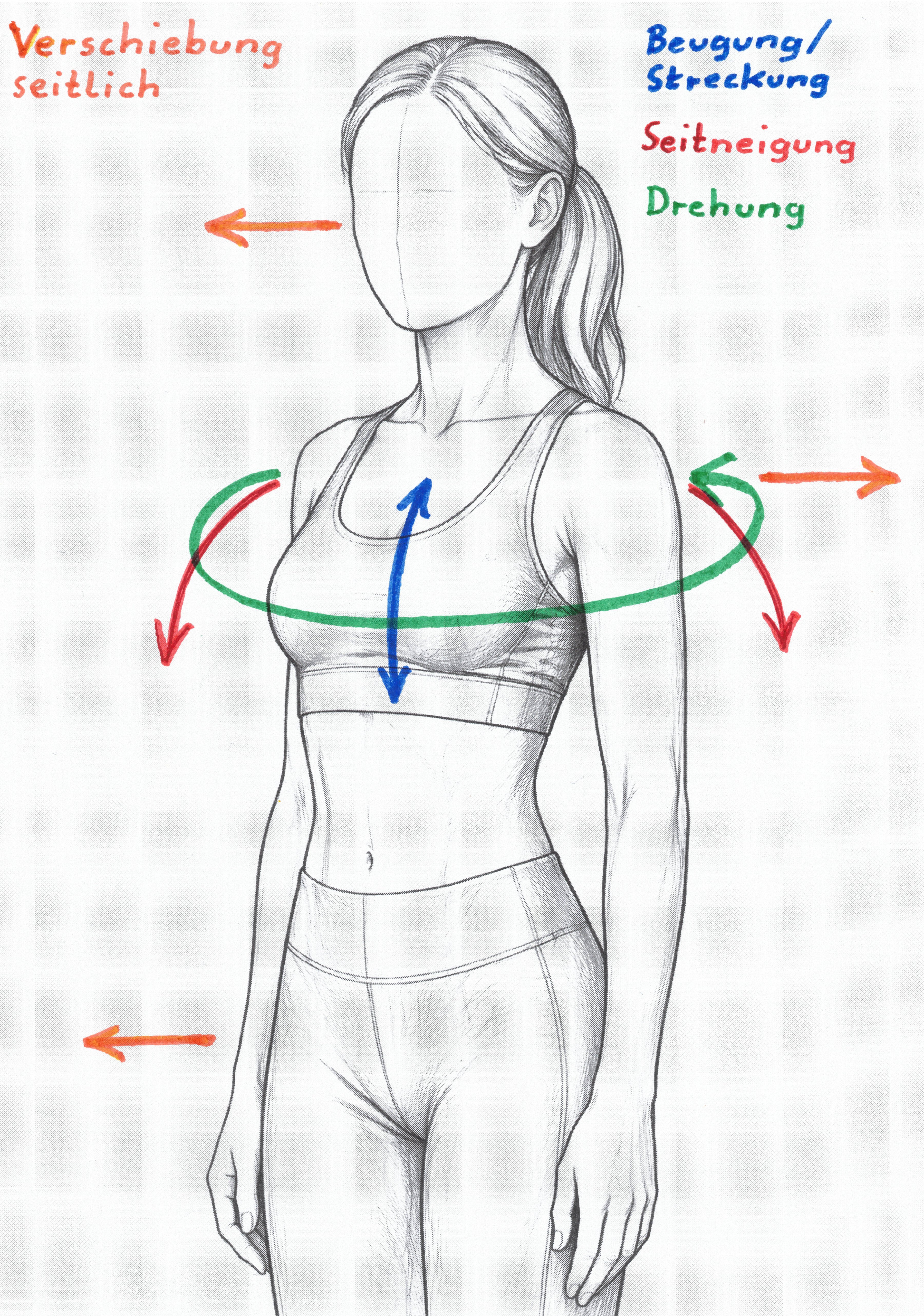
Your ability to express a wide range of emotions and moods when singing depends directly on the flexibility of your spine. There are five basic movements that a flexible spine should be able to perform: Bending (flexion), stretching (extension), lateral bending (lateral flexion), turning (rotation) and shifting (translation). Here you can see them in a drawing:
It is advantageous to start with an exercise for the first form of movement, the Diffraction. It is a simple vertebral rolling exercise that uses a movable „concentration point“ to individually target and loosen the segments of the spine - a good loosening exercise for singing too, as blockages in one section of the spine are inevitably transferred to the larynx and breathing muscles. It's best to do it like this:
- Stand up straight and slowly lower your head. Imagine how a point slides down vertebra by vertebra from your neck to your lumbar vertebrae as you roll your back (your pelvis remains stable and your legs slightly bent). Then slowly straighten up again in reverse order. This exercise trains your awareness of your spine and releases deep-seated tension.
- You can also do a similar exercise in the Lateral tilt to the left and right. Upper bodyrotations to the left and right (flowing, without swing) are a good finish to loosen things up.
The „shift“ and an exercise from pantomime
The latter is a rarely recognised form of spinal movement Postponement (also known as „translation“). It offers a wide range of expressive possibilities for singing performance. Reason enough to give it a try.
This involves moving the spine sideways in a horizontal line (to the left and right, as shown in the picture above) or forwards and backwards. The head, ribcage and pelvis can be moved parallel to each other. The neck and mid-body act as movable intermediate links during translation.
A good example of this is the Body wave, an exercise that I know from my training with my father, the mime Eberhardt Kube. All possible S-curves of the spine are captured in the body wave. This gives you a pool of basic postures from which you can „build“ different figures and trace the corresponding „inner postures“.
- The head provides the impulse for the body wave forwards, the pelvis is the passive end. Your head tilts and moves downwards close to your sternum. As if the head wanted to pass under an obstacle, it now stretches forwards. Then the head straightens up again and, by reaching upwards at an angle, pulls your body back into an upright position.
- In a variation of the exercise, you stop your movement during the body wave at different bends - and walk through the room with the „frozen“ posture. This allows you to slip into completely different figures and feel how this feels: the same - different - matching which feelings or moods?
- Tip: Do the body wave with the help of a partner or a friend who gives you the impulses with selective touch. Stand upright with your feet shoulder-width apart. Then the other person taps you at different points on your upper body and moves this point towards or away from your partner. The rest of your body follows.
With body wave exercises, you not only test the various movement possibilities of the spine and improve the mobility of your back. You also build up a repertoire of physical expression possibilities for the lyrics of your songs.
From postural extremes to the balanced centre
After all the posture variations you try out, always return to the basic posture - the „vertical“ posture explained at the beginning. It is the basis of basic vocal tension. It is also the centre between two extremes, which are well known in vocal pedagogy because so many people fall into one of these extreme postures when singing: the bent, „slumped“ posture on the one hand and the overstretched, „overcommitted“ posture on the other. Both lead to problems when singing.
In the slumped posture, you sing with a hunched back or a slumped chest and your shoulders are pulled forwards. This hinders breathing and the support of the sound, i.e. the even flow of air on which a stable sound depends. The result: too little air when singing, unsteady, wavering tones, no free, full vocal sound, but rather compressed tones, especially in the high register.
What is missing in the slack, bent posture is too much tension in the over-committed posture. A stance with raised shoulders and chin pulled back leads to an artificial darkening of the sound and to rapid fatigue when singing.
The knees also play an often underestimated role. Pressed, „locked“ knees almost always lead to the pelvis tilting forwards and a hollow back. This impairs the mobility of the spine and unfavourably reinforces the entire body statics when singing.
Therefore, at the end, make another Check your upright posture:
- Stand with your feet shoulder-width apart (one foot slightly in front of the other),
- Your knees are loosely stretched (neither bent nor straightened),
- Your hips are upright (without tensing your abdominal muscles),
- Your sternum is „elegantly“ raised,
- Your shoulder girdle is relaxed and your arms hang down loosely,
- Your neck is elongated and your head can turn effortlessly in all directions.
Conclusion
Your posture is the basis of your body language when you sing. It conveys basic information to the audience about the feelings, moods and dramas in your song. Our tip: utilise the diverse repertoire of postures offered by the movements of your spine. Experiment with various poses, e.g. with power poses. However, always start from the basic posture - and return to the basic posture: the upright posture „in plumb“. Then you will always end up with a balanced body posture when singing, and singing will be fun!
Choral voice training - 4 weeks free of charge with your whole choir: singasong-behappy.de/choric-voice-training